
by Emmitt Barry, Worthy News Washington D.C. Bureau Chief
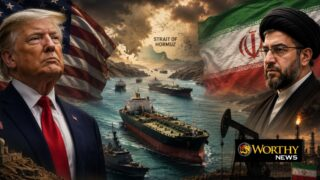
(Worthy News) – The United States is assembling a formidable military force in the Middle East amid growing indications that President Donald Trump could dramatically escalate operations against Iran following the November 3 midterm elections, even as Tehran intensifies attacks on commercial shipping and Washington faces mounting political pressure over the prolonged conflict.
A senior U.S. military official told the Daily Caller News Foundation that American strikes against Iran, which have slowed in recent weeks, could rapidly intensify as additional aircraft carriers, Marines, and combat aircraft move into position.
“Things are about to get spicy,” the official warned, speaking anonymously about the military preparations.
The buildup comes as Trump balances two competing objectives: preventing Iran from obtaining nuclear weapons and avoiding a broader military confrontation that could further damage Republican prospects in the upcoming congressional elections.
Massive American Military Buildup Underway
Approximately 9,000 additional American sailors and Marines are deploying aboard the USS Theodore Roosevelt carrier strike group and USS Makin Island amphibious ready group, potentially bringing the U.S. naval presence in the region to more than 20,000 personnel and three aircraft carriers by late October, according to the Daily Caller, citing Associated Press reporting.
American aerial refueling activity over the Middle East reportedly increased approximately 50% during the first two weeks of October compared with September, while military transport flights also rose sharply.
The deployments could provide Washington with the ability to conduct sustained air operations against Iranian military installations, missile infrastructure, and strategic targets.
However, military analysts caution that the buildup does not necessarily mean an attack has been ordered.
Retired Army Col. Steve Bucci, a visiting fellow at the Heritage Foundation, told the Daily Caller that the deployments likely serve as both a warning and a credible military option.
“It is more than likely a signal and a threat, with the hope it will not be needed, but with a full readiness to use it,” Bucci said.
Trump: No Strikes Before November 3
Despite the military preparations, Trump publicly declared on October 8 that the United States would not launch additional attacks against Iran before the midterm elections.
“We will not be attacking Iran at any time prior to the midterm elections to be held in the United States on November 3rd,” Trump wrote on Truth Social, according to Reuters.
He also emphasized that Washington and Tehran were engaged in productive discussions aimed at ending the conflict.
Nevertheless, Trump has repeatedly warned that Iran must abandon its nuclear ambitions.
“IRAN WILL NOT HAVE A NUCLEAR WEAPON!” the president declared.
The administration’s willingness to negotiate has been accompanied by increasingly severe warnings.
Addressing the United Nations General Assembly on September 22, Trump acknowledged that he faced a major decision concerning Iran, including whether to “annihilate the Islamic Republic and do it quickly.”
The contrast between Trump’s diplomatic overtures and military threats reflects a strategy of maintaining maximum pressure while leaving Tehran uncertain about Washington’s next move.
Iran Escalates Attacks on Shipping Through Strait of Hormuz
Meanwhile, Iran has stepped up attacks against commercial vessels in and around the Strait of Hormuz, one of the world’s most strategically important energy corridors.
According to an October 14 assessment cited by the Daily Caller, Iranian forces struck at least 24 vessels between September 28 and October 11, while two additional cargo ships reportedly sank on October 14.
Reuters reported that Tehran has adjusted its maritime tactics, increasingly relying on small boats and human observers after American strikes damaged Iranian coastal surveillance infrastructure.
Iranian officials have also reportedly sought to use disruptions to international shipping and rising energy prices to increase pressure on Washington ahead of the elections.
The economic consequences are becoming increasingly apparent. Associated Press reporting indicates that American gasoline prices have risen approximately 45% since the war began in February, while diesel prices have climbed 68%.
Netanyahu and Trump Face Critical Decisions
The possibility of renewed military action is further complicated by Israel’s political calendar.
Axios reported on October 13 that Israeli Prime Minister Benjamin Netanyahu and Trump have held multiple discussions concerning another major operation against Iran.
With Israeli elections scheduled for October 27 and American congressional elections following November 3, the two leaders face overlapping political and military pressures.
According to the report, Trump initially expressed interest in another operation but subsequently appeared more hesitant.
The deliberations underscore a central question facing Washington and Jerusalem: whether additional military force can decisively weaken Iran’s remaining military capabilities or whether renewed strikes would trigger another prolonged regional confrontation.
Polls Reveal Growing American Opposition
Public opinion presents another obstacle for the administration.
A Pew Research Center survey released October 8 found that 65% of Americans disapprove of Trump’s handling of military operations against Iran, compared with 33% who approve.
An October 15 AP-NORC survey found that 64% of Americans consider the Iran conflict an important issue in determining their midterm vote.
Earlier AP-NORC polling also found that 69% believe the war has not been worth fighting.
Nevertheless, the administration continues to argue that preventing a nuclear-armed Iran remains a critical American national security objective.
Reuters reported in September that senior White House advisers had sought to contain the conflict until after the elections, while preserving the option of renewed military operations.
One administration official summarized the political calculation in comments reported by Reuters: “November is a priority.”
For now, Washington appears to be pursuing diplomacy backed by overwhelming military power. Whether that pressure produces an agreement or precedes another major confrontation remains uncertain.
What is increasingly clear is that the coming weeks could prove decisive for Iran, Israel, and the broader Middle East, as the United States positions itself for military options that extend well beyond the November elections.
Copyright 1999-2026 Worthy News. This article was originally published on Worthy News and was reproduced with permission.