
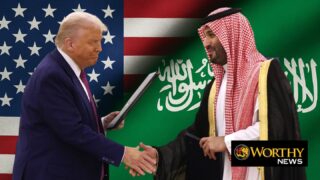
Riyadh’s direct military intervention marks a consequential escalation as Iranian proxies target U.S. forces and Saudi energy infrastructure
by Emmitt Barry, Worthy News Washington D.C. Bureau Chief
WASHINGTON D.C. /BAGHDAD (Worthy News) – The widening war between the United States and Iran entered a dangerous new phase Wednesday as American and Saudi forces carried out coordinated strikes against Iran-backed militias across Iraq, marking the first publicly acknowledged joint combat operation of its kind between Washington and Riyadh.
U.S. Central Command said the precision strikes targeted Iran-aligned groups directed by the Islamic Revolutionary Guard Corps to attack American personnel and Saudi energy installations. The operation followed more than 30 reported drone attacks or attempted attacks against U.S. forces and Saudi targets over several days.
Saudi Arabia confirmed that its armed forces participated in the July 29 operation “in coordination with the United States,” saying the targeted militias had repeatedly used Iraqi territory to launch attacks against the kingdom. Saudi officials said the strikes were intended to halt continuing threats against the nation’s security and critical infrastructure.
The Iran-backed Popular Mobilization Forces said at least 20 of its members were killed and 32 others wounded as strikes hit militia positions across several Iraqi provinces. The organization, known in Arabic as the Hashd al-Shaabi, is formally incorporated into Iraq’s security establishment, although several of its most powerful factions retain deep operational and ideological ties to Tehran.
Saudi officials said the military response followed drone attacks launched from Iraq against oil facilities in the kingdom’s Eastern Province. Saudi air defenses reportedly intercepted the drones, but Riyadh warned Baghdad that Iraqi territory could not be allowed to serve as a staging ground for attacks against Saudi cities and energy installations.
The strikes represent a major strategic shift for Saudi Arabia, which has previously sought to avoid becoming openly entangled in the direct military confrontation between Washington and Tehran. Riyadh’s public participation now signals that Iranian proxy attacks on Saudi infrastructure have crossed what the kingdom considers an unacceptable threshold.
The Iraqi government condemned the American-Saudi operation as a violation of national sovereignty, placing Baghdad in an increasingly difficult position. Iraq’s government depends politically and militarily on institutions that include Iran-linked factions, yet it also maintains vital security and economic relationships with Washington and neighboring Gulf states.
The escalation came as Iran renewed direct attacks against American forces, launching ballistic missiles toward a U.S. base in Jordan. President Donald Trump vowed powerful retaliation, and U.S. officials said the attempted strike demonstrated that Tehran and its proxies remained prepared to expand the battlefield beyond Iran’s borders.
The conflict is also threatening global energy markets. Oil prices surged amid fears that continued attacks on Saudi facilities, Gulf shipping lanes and regional military bases could disrupt supplies moving through the Strait of Hormuz, the Red Sea and the Bab el-Mandeb waterway.
The widening confrontation carries consequences far beyond Iraq. By drawing Saudi Arabia openly into combat against Iran’s regional network, Tehran’s use of proxy forces may be accelerating the very regional alignment it has long sought to prevent. Gulf nations that once attempted to balance between Iran and the United States are increasingly being forced to choose sides as attacks reach deeper into their territory.
For years, Iran has projected power throughout the Middle East through militias operating beyond its borders. But as those forces strike neighboring nations, the boundaries between proxy warfare and direct regional war are rapidly disappearing. What began as a confrontation centered on Iran now threatens to ignite overlapping fronts across Iraq, Jordan, Saudi Arabia, Yemen and the Gulf.
Copyright 1999-2026 Worthy News. This article was originally published on Worthy News and was reproduced with permission.