
by Emmitt Barry, Worthy News Washington D.C. Bureau Chief
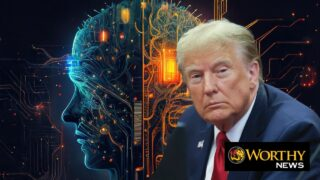
(Worthy News) – President Donald Trump is proposing a new “AI Force” modeled on the United States Space Force, placing artificial intelligence near the center of America’s economic and national-security strategy.
The president announced the initiative in a Sept. 19 Truth Social post, saying he would also appoint an “AI czar” to oversee his administration’s approach to the rapidly developing technology. He promised that the federal government would protect the industry’s growth while using existing criminal and civil laws to address abuses.
“We will not in any way hinder or stifle the Growth of this incredible Industry,” Trump wrote. “Rather, we will cherish it, help it, and watch over it, as it grows!”
Trump compared the proposed organization to the Space Force, the military service established during his first administration. That comparison immediately raised the possibility that the AI Force could become part of the nation’s defense structure.
For now, however, the administration has not said whether the organization would be a military service, a Pentagon command, a civilian agency or a White House-led task force. Its mission, leadership structure, budget and legal authority also remain undefined.
From AI Force to ‘Super Intelligence’
Trump carried his argument onto the world stage during his Sept. 22 address to the United Nations General Assembly.
“The use of the word artificial makes intelligence fake,” Trump told world leaders. “It makes it sound fake, and it is not fake. It’s actually amazing.”
The president said federal documents would begin using “super intelligence,” or “SI,” in place of artificial intelligence. As of his address, the White House had not released an executive order or other formal directive implementing that change across the government.
The terminology may be unconventional, but Trump’s larger message was unmistakable: The United States does not intend to retreat from the race for technological leadership.
That competition is about far more than consumer chatbots. Artificial intelligence can help analyze intelligence, defend computer networks, coordinate autonomous systems, improve logistics and accelerate weapons development. It can also produce convincing false information, introduce errors into military decision-making and place enormous power in systems that human operators may not fully understand.
Trump has argued that imposing broad restrictions could surrender America’s advantage to China. His critics, including some technology executives and lawmakers from both parties, contend that advanced systems require stronger safeguards before they become even more capable.
The central question is not whether America should lead. It is how the country can lead without allowing speed to replace judgment.
Is the AI Force Really a New Military Branch?
Not yet.
The Space Force precedent matters because creating a military service requires more than a presidential announcement. Trump championed the Space Force, but it formally came into existence in December 2019 when he signed the National Defense Authorization Act passed by Congress.
An AI Force established as an independent armed service would likewise require congressional action. The president could more readily create an advisory council, interagency task force, or White House coordinating office using executive authority.
A Pentagon-based organization is another possibility. The Defense Department already has offices and programs devoted to artificial intelligence, including the Chief Digital and Artificial Intelligence Office. Its 2026 AI strategy calls for building an “AI-first” fighting force and accelerating what the department describes as American “Military AI Dominance.”
That existing structure may make a completely separate military service unnecessary. An AI Force could instead coordinate work already underway across the Army, Navy, Air Force, Marine Corps, Space Force and intelligence community.
The answer will depend on whether the administration sees AI as a distinct theater of conflict, like space, or as a capability that must be woven through every part of government and national defense.
A Contest With China
Washington and Beijing increasingly regard artificial intelligence as a foundation of economic power and military strength. Both nations are investing in advanced computing, autonomous weapons, cyber capabilities, and the enormous data centers needed to train increasingly powerful systems.
The United States retains major advantages in advanced chip design, private investment and frontier AI research. China brings its own formidable strengths, including manufacturing capacity, state-directed financing and an ability to mobilize national resources around strategic industries.
Trump’s position is that America cannot regulate itself into second place. That argument will appeal to voters who have watched critical manufacturing and supply chains move overseas over several decades.
Yet national strength requires more than rapid development. It also requires reliable systems, secure infrastructure, and leaders willing to distinguish genuine warnings from political maneuvering. In military affairs, an AI system that produces a fast but false conclusion can be more dangerous than a slower human process.
American leadership will therefore depend on both innovation and discipline.
Congress Will Determine What Comes Next
The president’s proposal has opened a serious discussion, but important decisions still belong to Congress.
Lawmakers would have to determine the AI Force’s legal authority, funding, oversight, and relationship with existing agencies. They would also need to decide whether its purpose is military readiness, civilian innovation, industry regulation, or some combination of all three.
Those distinctions matter. A military service is accountable through a defined chain of command and congressional authorization. A White House task force would have a different mission and fewer institutional powers. An independent agency would raise still more questions about jurisdiction and regulation.
Trump has placed a marker: America must treat artificial intelligence as a strategic national priority. His United Nations remarks reinforced that determination, even as the proposed change from “artificial” to “super” intelligence drew attention of its own.
The administration must now turn a memorable name into a coherent policy. If the AI Force is to become more than a slogan, it will need a clear mission, constitutional accountability, and men and women who understand that technology must remain a servant of the nation—not its master.
A Prophetic Question for the Digital Age
For Christians, the rise of centralized artificial intelligence carries a significance that reaches beyond military strategy or economic competition. Scripture describes a future system of extraordinary control—one in which “no man might buy or sell” unless he possesses the mark of the beast, according to Revelation 13:17.
The Bible does not identify artificial intelligence as that system, and wisdom demands that believers avoid forcing every new technology into a prophetic timetable. Yet it would be equally unwise to ignore what is taking shape before us.
A sufficiently powerful AI network, joined with digital identification, financial surveillance and programmable currency, could create the practical machinery for controlling who may participate in ordinary commerce. What once seemed impossible—the immediate monitoring and restriction of buying and selling across nations—has become technologically conceivable.
Daniel 12:4 also speaks of the time of the end, when “many shall run to and fro, and knowledge shall be increased.” The passage has prompted generations of Christians to consider whether unprecedented travel, communication and expanding knowledge might help prepare the world for the conditions described in biblical prophecy.
Artificial intelligence now places vast stores of human knowledge within reach in seconds. Information moves continually across borders, devices and data centers. The world is becoming more connected, more informed and, at the same time, more capable of centralized control.
None of this proves that Trump’s proposed AI Force fulfills a specific prophecy. It does, however, remind believers that technological power is never spiritually neutral. The same systems that defend a nation, cure disease or strengthen an economy can also be turned toward surveillance, coercion and control.
America should pursue technological strength, especially while hostile powers are racing to secure the same capabilities. But national strength must remain accountable to moral truth, constitutional liberty and the God-given dignity of every human being.
The real danger is not simply that machines may become more intelligent. It is that men may build a system powerful enough to rule over human life—and then surrender to it the authority that belongs to God alone.
Christians need not respond with panic. Scripture calls for discernment, faithfulness and watchfulness. As knowledge increases and systems of power grow more capable, the church must remain clear-eyed about the age while refusing to place its ultimate trust in governments, markets or machines.
Technology may shape the future, but it does not rule history. God does.
Copyright 1999-2026 Worthy News. This article was originally published on Worthy News and was reproduced with permission.