
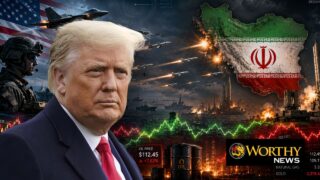
President warns Tehran it will be hit “very hard” as renewed fighting threatens diplomatic efforts and sends oil prices soaring
by Emmitt Barry, Worthy News Washington D.C. Bureau Chief
WASHINGTON (Worthy News) – The United States unleashed a heavy wave of airstrikes against Iran early Thursday after President Donald Trump vowed severe retaliation for Tehran’s surprise ballistic missile attack on American forces stationed in Jordan.
U.S. Central Command said American forces struck dozens of targets connected to Iran’s Islamic Revolutionary Guard Corps during a two-hour operation. The targets reportedly included military command centers, missile and drone facilities, coastal surveillance positions, and air-defense sites.
The operation followed Iran’s launch of five ballistic missiles toward Jordan’s Muwaffaq Salti Air Base, a strategic installation used by American forces. Jordan’s military said all five missiles were intercepted and destroyed before reaching their target.
Speaking before the retaliatory strikes, Trump said Iran had attempted to catch the United States by surprise but failed.
“We’re going to be hitting them very hard because it’s our turn to hit them,” Trump told reporters during an Oval Office event.
The latest American attack was broader than several recent retaliatory operations but did not represent a complete return to the large-scale combat campaign conducted earlier in the conflict, a U.S. official told The Wall Street Journal. The military described the operation as a “powerful response” to Iran’s direct attack against American personnel.
Iranian state media reported explosions in Khuzestan province and on Qeshm Island, a strategically important location near the Strait of Hormuz. At least two people were reportedly injured, although the full extent of the damage was not immediately known.
The escalation came shortly after American and Saudi forces conducted coordinated strikes against Iran-backed militias in Iraq. Iraqi militia officials said at least 20 fighters and six Iranian advisers were killed, while Iraq’s government condemned the operation and reported civilian casualties.
The renewed fighting has dealt another blow to diplomatic efforts aimed at restoring a ceasefire and reopening the Strait of Hormuz. Iran also rejected an Omani proposal for jointly managing maritime traffic through the strategic waterway, insisting that shipping conditions would not return to their prewar arrangement.
Oil markets reacted sharply to the widening conflict. Brent crude rose nearly 8% to settle at $90.74 per barrel, while West Texas Intermediate climbed more than 6% to $84.46. Shipping through the Strait of Hormuz remained severely restricted, intensifying concerns about global energy supplies.
The attacks demonstrate the growing danger facing Tehran as it continues to confront the United States, Israel, and an expanding coalition of regional powers. Trump has repeatedly warned that attacks against American troops or allied infrastructure will bring overwhelming retaliation—a warning Iran tested directly and was answered within hours.
Copyright 1999-2026 Worthy News. This article was originally published on Worthy News and was reproduced with permission.