
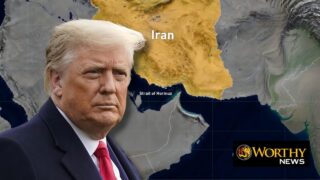
President says diplomacy now has a narrow opening, but Tehran’s nuclear ambitions and control of the Strait of Hormuz remain unresolved
by Emmitt Barry, Worthy News Washington D.C. Bureau Chief
(Worthy News) – President Donald Trump called off a planned military attack against Iran over the weekend, saying Tehran and several Middle Eastern governments had asked Washington to give diplomacy another chance after negotiators agreed on the broad outlines of a possible deal.
The emerging framework would require the immediate and unrestricted reopening of the Strait of Hormuz and an end to Iran’s nuclear threat. Yet as talks move forward, the crucial details remain unsettled—and Iran has not publicly confirmed every element described by the president.
Trump announced the decision after warning that American forces were “locked and loaded” for an attack of extraordinary scale. He said the United States had been asked to hold its fire because what he called the “perimeters of a deal” had been established.
“Based on this request, I have agreed, for the future benefit of the world and, likewise, the survival of a successful and prosperous Iran, to cancel the attack, subject to being able to rapidly make a deal,” Trump wrote on Truth Social.
The president also said Israel had joined the American commitment to pursue an agreement.
“Get to work, everybody, and get it done,” he added.
Diplomacy Backed by the Threat of Force
The announcement reflects the central gamble behind Trump’s approach to Iran: that overwhelming military pressure can force Tehran to accept terms it has resisted for years.
The president did not remove the threat of force. He merely placed it on hold while negotiators determine whether Iran is prepared to make binding concessions.
According to JNS, American and Israeli forces had been preparing for renewed operations against Iranian targets, including critical energy infrastructure. Trump had said only a day earlier that Iranian representatives were testing his patience by lying and misrepresenting their position.
The administration’s message is therefore not one of unconditional retreat. Iran has been offered a narrow path away from further destruction, but the credibility of that path will depend upon its conduct.
Any serious agreement must do more than produce another temporary pause. It must prevent the Islamic regime from obtaining a nuclear weapon, protect Israel and America’s Arab partners, and restore lawful commercial passage through one of the world’s most important waterways.
Saudi Concerns Helped Open the Door
Trump’s decision followed a telephone conversation with Saudi Crown Prince Mohammed bin Salman.
The Saudi leader reportedly expressed concern that a major American attack on Iran’s power plants, bridges or energy installations could trigger Iranian retaliation against oil infrastructure in Saudi Arabia and other Gulf nations.
A White House official confirmed that Trump and the crown prince spoke, although the administration did not release details of their conversation. Qatar, the United Arab Emirates, Turkey and Pakistan have also encouraged Washington and Tehran to step back from another major escalation.
Those governments have compelling reasons to seek restraint. Their cities, ports and energy facilities would be among the first targets if Iran widened the conflict.
Their intervention also suggests that Tehran is feeling pressure not only from Washington and Jerusalem but from neighboring governments that have grown weary of living under the shadow of Iranian missiles, militias and maritime threats.
The Strait of Hormuz Remains Central
The proposed reopening of the Strait of Hormuz is not a minor provision. The narrow passage is one of the most consequential shipping routes on earth, historically carrying roughly one-fifth of global oil and liquefied natural-gas supplies.
Iranian attacks and restrictions in the strait have trapped vessels, disrupted commerce and driven energy prices higher. Following Trump’s announcement, U.S. crude and Brent crude prices each fell approximately 5 percent in Sunday trading, according to the Associated Press.
That immediate market reaction illustrates the worldwide stakes. A genuinely open strait would bring relief to American families and businesses already bearing the cost of instability. A vague promise that leaves Iran free to impose new restrictions or tolls would not.
No Final Agreement Yet
The president’s announcement should be understood for what it is: an opening, not a completed peace agreement.
Iran offered no immediate official response when the decision was first announced, according to the Associated Press. Iranian state media subsequently disputed reports that a final agreement concerning the strait had been reached.
That contradiction matters. Previous ceasefires and negotiating frameworks have broken down when Tehran resumed attacks on commercial shipping or disputed the obligations Washington believed it had accepted.
The United States therefore cannot afford to confuse hopeful language with verifiable compliance.
Israeli leaders and security experts remain particularly cautious. They have spent decades watching the Iranian regime use negotiations to gain time while advancing its nuclear program, strengthening terrorist proxies and threatening the destruction of Israel.
Their concern is not an objection to peace. It is a recognition that peace without truth, enforcement and strength rarely survives a determined aggressor.
A Test of Iran’s Intentions
Trump has given diplomacy another opportunity, but Tehran must now prove that it wants more than temporary relief from military pressure.
A durable agreement would require an enforceable end to Iran’s nuclear-weapons pathway, unrestricted international shipping through Hormuz and consequences for violations. Israel’s security cannot become a bargaining chip, nor can regional stability depend upon the goodwill of a regime that has repeatedly armed terrorist organizations and threatened its neighbors.
There is wisdom in avoiding war when honorable peace remains possible. There is also danger in mistaking delay for peace.
The coming negotiations will reveal which one this is.
Three Highlights
Copyright 1999-2026 Worthy News. This article was originally published on Worthy News and was reproduced with permission.