
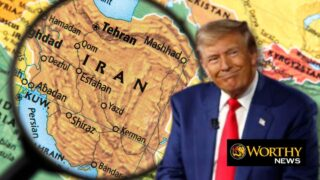
President warns Tehran of devastating consequences if negotiations fail, while Iranian officials deny direct talks with Washington
by Emmitt Barry, Worthy News Washington D.C. Bureau Chief
(Worthy News) – President Donald Trump delivered a stark warning to Iran on Monday, saying its leaders have one final opportunity to reach an agreement with the United States before facing what he described as “decapitation.”
“I think we’re going to maybe get something, but I want to give them every last chance before decapitation,” Trump told reporters.
The president said negotiations were already underway at Tehran’s request, with Saudi Arabia, the United Arab Emirates, Qatar and other regional governments encouraging the diplomatic effort. He called the discussions Iran’s “last chance” to sign a favorable agreement.
Iranian officials, however, disputed Trump’s account. Tehran maintained that it was negotiating with Oman over maritime security rather than holding direct talks with the United States. The conflicting claims continued a pattern in which Washington has announced diplomatic progress only for Iran to deny that formal negotiations are taking place.
Trump accused Iran’s leaders of being “unbelievably duplicitous,” saying they had privately sought talks while publicly denying any contact with his administration.
“They ask for a meeting, some would say ‘beg,’ talks begin, with more scheduled in the immediate future, and they say, openly and proudly, that they’re not having any discussions,” Trump wrote on Truth Social.
Hormuz at the Center of the Crisis
The immediate dispute centers on the Strait of Hormuz, the narrow waterway connecting the Persian Gulf to the Gulf of Oman. Before the conflict, roughly one-fifth of the world’s traded oil and natural gas moved through the strait, making freedom of navigation there a matter of global economic security.
Oman has reportedly presented Iran with a Gulf-backed proposal for managing the waterway. The plan would include voluntary payments from nations using the strait, according to regional sources cited by Reuters.
Tehran is seeking a larger role, including administrative authority and the power to charge vessels service fees. Washington has rejected Iranian control and insists that the strait must remain an international waterway open to commercial shipping.
Trump said the United States would not permit Iran to dictate passage through the region.
The president declared that the U.S. Navy already controls the strait and said the American blockade would remain in place unless Iran accepts an agreement or surrenders. His administration’s central demand has not changed: Iran must never be permitted to obtain a nuclear weapon.
Iran Tests American Resolve
Gulf officials believe Iran is pursuing a calculated strategy of escalation. Tehran cannot match American military power directly, but it can threaten shipping, energy facilities and other vulnerable infrastructure to raise the price of continued confrontation.
Iran appears to be betting that the United States and its regional partners will tire of protecting trade routes before Tehran yields to American demands.
“The Iranians believe that by widening the war and increasing the pressure, [Trump] will eventually give in,” one Gulf official told Reuters.
That strategy extends beyond Hormuz. Threats to the Bab el-Mandeb strait, which connects the Red Sea with the Gulf of Aden, could force the United States and its allies to devote still more naval and intelligence resources to defending international commerce.
A Saudi-led maritime coalition is reportedly taking shape around that defensive mission, with an emphasis on escorting commercial vessels, sharing intelligence and protecting shipping lanes.
Iran may view every ship diverted, every insurance premium raised and every naval asset committed to defense as additional negotiating leverage. The regime’s leaders appear convinced that pressure—not compromise—will produce better terms.
A Choice Between Diplomacy and Force
Trump’s warning leaves Iran with a clear choice. Tehran can accept an enforceable agreement that protects international shipping and addresses its nuclear ambitions, or it can risk another severe American military response.
The president said he had already shown restraint by holding back an attack Iran knew was coming.
“I showed mercy,” Trump said. “Iran knew what was coming. Nothing would have remained.”
That restraint should not be mistaken for weakness. Diplomacy is worth pursuing when it protects innocent lives and advances a just peace, but peace cannot rest on empty promises from a government that has repeatedly used terrorism, proxies and threats against civilian commerce as instruments of policy.
Iran’s leaders now have an opportunity to step back from the brink. Whether they take it—or gamble once more against American resolve—could determine the security of the Middle East and the stability of energy markets around the world.
Copyright 1999-2026 Worthy News. This article was originally published on Worthy News and was reproduced with permission.