
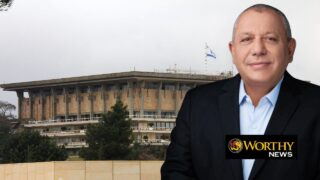
by Emmitt Barry, Worthy News Washington D.C. Bureau Chief
(Worthy News) – Israeli opposition leader Avigdor Liberman has signaled a dramatic shift in his longstanding opposition to governing alongside ultra-Orthodox parties, potentially opening the door for Gadi Eisenkot to form a 61-seat coalition that would exclude both Prime Minister Benjamin Netanyahu and the Arab parties when Israel’s newly elected Knesset is sworn in on November 10.
Liberman, chairman of the seven-seat Yisrael Beytenu party, announced Friday that he was prepared to compromise on legislation requiring ultra-Orthodox men to serve in the Israel Defense Forces, a contentious issue that has repeatedly divided Israel’s political establishment.
According to Israel National News and i24NEWS, Liberman argued that the election results demand difficult political compromises to prevent another election and bring Netanyahu’s lengthy tenure as prime minister to an end.
His announcement could fundamentally reshape coalition negotiations following the October 27 elections, which left Netanyahu’s right-wing and religious bloc with 53 seats, Eisenkot’s opposition bloc with 48, and the two Arab parties holding a combined 19 seats.
Until now, Eisenkot’s path to power appeared to depend on parliamentary support from the Arab parties, an arrangement Liberman has repeatedly rejected.
However, by bringing the ultra-Orthodox United Torah Judaism and Shas parties into negotiations, Eisenkot could assemble a narrow parliamentary majority without relying on either Arab faction.
The Numbers: How Eisenkot Could Form a 61-Seat Government
Based on the official election results for Israel’s 26th Knesset, a coalition combining Eisenkot’s four-party opposition bloc with both ultra-Orthodox parties would reach exactly the 61 seats needed for a majority in the 120-member parliament.
A potential coalition led by Gadi Eisenkot would command a narrow 61-seat majority in Israel’s 120-member Knesset, bringing together six political parties.
Eisenkot’s Yashar party would contribute 21 seats, followed by former Prime Minister Naftali Bennett’s B’Yachad party with 12 seats, Yair Golan’s Democrats with eight seats, and Avigdor Liberman’s Yisrael Beytenu with seven seats. Together, these four parties would account for 48 seats, falling 13 short of a parliamentary majority. However, the addition of the two ultra-Orthodox parties—United Torah Judaism with seven seats and Shas with six—would bring the coalition to exactly 61 seats, leaving 59 lawmakers in opposition.
Such an arrangement would allow Eisenkot to form a government without Prime Minister Benjamin Netanyahu’s Likud party or support from the Arab parties, marking a significant political realignment in Israel.
The arrangement would leave Netanyahu’s Likud party and its remaining right-wing allies with 40 seats outside the government, alongside the 19 Arab lawmakers.
The critical development is that Eisenkot would no longer need support from Ra’am or the Joint List to secure a parliamentary majority, provided both ultra-Orthodox parties agree to join his government.
Ultra-Orthodox Parties Could Become Kingmakers
United Torah Judaism, which won seven seats, has already indicated a willingness to explore coalition negotiations, provided an acceptable solution can be reached on military conscription for ultra-Orthodox men.
Shas, which holds six seats, would provide the remaining votes necessary to reach 61.
Liberman’s willingness to compromise is particularly significant because disputes over ultra-Orthodox military service have historically prevented cooperation between his secular nationalist party and Israel’s religious factions.
Yet serious ideological differences remain. Eisenkot would also need to reconcile the demands of the ultra-Orthodox parties with those of Yair Golan’s left-wing Democrats, who hold eight seats and have advocated greater equality in military service obligations.
Liberman has emphasized three priorities: ending Netanyahu’s premiership, preventing another election, and refusing to establish a government dependent on Arab-party support.
According to The Times of Israel, he also suggested that a new coalition could eventually attract three or four Likud lawmakers, potentially expanding its parliamentary majority and providing greater stability.
November 10 Could Mark a Political Turning Point
President Isaac Herzog is expected to announce Sunday which political leader will receive the mandate to form Israel’s next government, with Eisenkot positioned as the leading candidate after receiving recommendations from 67 lawmakers during presidential consultations.
The incoming Knesset is scheduled to be sworn in Tuesday, November 10, giving the opposition an opportunity to begin exercising its parliamentary strength.
However, the swearing-in does not automatically establish a new government. Eisenkot would still need to negotiate coalition agreements, secure the necessary parliamentary backing, and obtain the Knesset’s confidence before replacing Netanyahu.
A 61-seat agreement involving both ultra-Orthodox parties would give Eisenkot a viable route to power, but it would leave his government dependent on every coalition lawmaker.
With the ultra-Orthodox parties potentially holding the balance of power, Liberman’s unexpected concession has transformed what appeared to be an electoral stalemate into a genuine opportunity for a new government.
For the first time since the election, a government excluding both Netanyahu and the Arab parties is mathematically possible without defections from Likud. Whether that possibility becomes reality now depends on the willingness of Israel’s secular, centrist, left-wing, and ultra-Orthodox leaders to put aside their differences.
Copyright 1999-2026 Worthy News. This article was originally published on Worthy News and was reproduced with permission.