
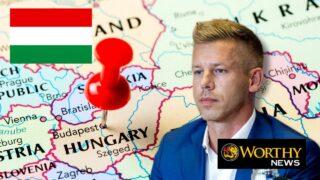
by Stefan J. Bos, Worthy News Europe Bureau Chief reporting from Budapest, Hungary
BUDAPEST, HUNGARY (Worthy News) – Hungary’s new government is moving to dismantle key restrictions affecting homosexual and transgender people introduced under former Prime Minister Viktor Orbán, including rules that effectively prevented gay people from adopting children.
Prime Minister Péter Magyar confirmed that his cabinet will change the Orbán-era adoption system, under which unmarried applicants require approval from the minister responsible for family affairs.
The restriction, introduced in 2020, effectively halted adoption by same-sex couples because Hungary does not allow them to marry. Before the change, gay or lesbian couples could effectively adopt when one partner applied as a single person.
Hungary’s constitution defines marriage as a voluntary union between “one man and one woman.” It also states that family relationships are based on marriage and the parent-child relationship and declares: “The mother is a woman, the father is a man.”
Same-sex couples can enter registered partnerships in Hungary, but these do not provide the same adoption rights as marriage.
ADOPTION RULES CHANGING
“We can state unequivocally that we will change this system,” Magyar said.
Magyar, a self-declared right-wing conservative, appeared to open the door to adoptions by gay couples, saying individual decisions should be made by child-protection professionals rather than politicians.
However, speaking to Hungary’s Kossuth Radio, he stopped short of explicitly promising full joint-adoption equality for same-sex couples.
Yet Magyar signaled a significant change in tone toward Hungary’s homosexual community, saying people should be free to love whom they choose and should not face hostility because of their sexual orientation.
“Love is free, it is a fundamental right, and in a humane country this cannot be a question,” Magyar added.
‘LOVE IS FREE’
He said homosexual as well as heterosexual Hungarians, believers, atheists, Budapest residents and people living in the countryside should have a voice in discussions surrounding a planned new constitution.
The shift comes amid a wider crisis in Hungary’s child-protection system, with a government investigation documenting physical and sexual abuse, neglect, hunger, staff shortages and inadequate placements for vulnerable children.
Magyar has questioned whether a traumatized child without a family is necessarily better off in institutional care than with a loving same-sex couple.
His cabinet is also rewriting controversial 2021 “child protection” legislation introduced under Orbán that restricted content related to LGBTQ+ issues accessible to minors.
Under legislation submitted to parliament Monday, references to promoting or portraying homosexuality, gender transition or departure from birth-sex identity would be removed from those restrictions.
LGBTQ+ REFERENCES REMOVED
Instead, the proposed law focuses on pornography, age-inappropriate sexual material and content promoting sexual violence, exploitation, grooming or other sexual crimes, as well as material considered seriously harmful to a child’s development.
The move follows an April ruling by the European Union’s top court that Hungary violated EU law through restrictions on content related to LGBTQ+ issues that the court concluded discriminated against and stigmatized gay and transgender people.
Magyar explained that changing the legislation could help Hungary avoid financial penalties linked to the dispute and assist efforts to recover about 500 million euros ($590 million) in European Union education funding.
Orbán had defended the so-called child protection law as part of what he viewed as Hungary’s defense of traditional Christian family values, despite criticism from LGBTQ+ activists and the European Union.
His government later expanded the legislation to effectively ban Pride gatherings, allowing authorities to prohibit rallies deemed to violate the child-protection measures and introducing fines for participants.
PRIDE GATHERINGS TARGETED
The measures prompted mass demonstrations in Budapest and criticism from European officials and human rights groups, who argued that child protection was being used to restrict freedom of assembly and the rights of sexual minorities.
Orbán rejected such criticism, portraying his policies as protecting children and Hungary’s traditional understanding of family against what he viewed as increasingly liberal Western attitudes toward sexuality and gender.
Magyar’s approach marks a significant departure from those policies, although his government says it seeks to strengthen protections for children after revelations about severe failures in Hungary’s state-care system.
During Orbán’s rule, Hungary also ended legal recognition of gender changes in official documents and imposed restrictions on educational and media content concerning LGBTQ+ issues.
Yet Magyar has left open how far the changes concerning same-sex couples will extend.
Copyright 1999-2026 Worthy News. This article was originally published on Worthy News and was reproduced with permission.